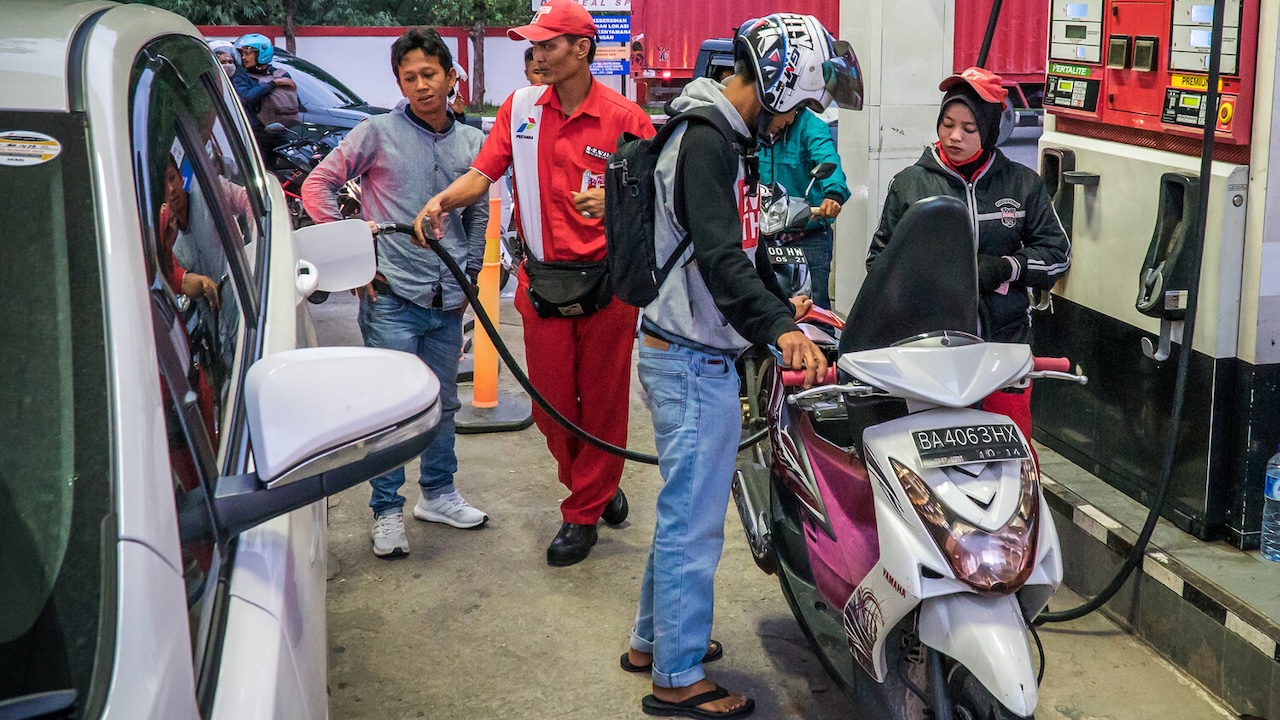
Biofuels are already well-established in Southeast Asia, meeting nearly 10% of road transport energy demand—twice the global average. Photo credit: ADB
Rural economies across ASEAN can attract billions in investments by creating a regional supply chain and market for biofuel and feedstock.
The 8th ASEAN Energy Outlook 2023–2050 has acknowledged biofuels’ importance for enhancing energy security and meeting climate objectives. Biodiesel and bioethanol are used in the transportation sector.
The region’s biofuel ambition also promises to benefit rural economies as it can potentially create new markets, jobs, and income streams in agricultural areas, according to a new report, Biofuel Market Potential for Regional Cooperation in ASEAN. The report was published by the Economic Research Institute for ASEAN East Asia (ERIA) and the ASEAN Centre for Energy (ACE).
Rural economies in BIMP-EAGA stand to benefit, as Kalimantan, Sabah, Sarawak, and Mindanao already produce biofuel feedstocks, such as sugarcane, cassava, palm oil, coconut, and corn.
However, stronger regional coordination is needed to address fragmented national biofuel efforts and build a cohesive market that delivers cheaper, greener fuel, while positioning ASEAN as a global leader in advanced biofuels. The lack of a unified approach has led to inefficiencies and hindered the development of a cohesive biofuel industry. Having harmonized standards and shared infrastructure is crucial to unlocking the region’s biofuel potential.
According to the report, diverting just 1 billion liters of biofuel trade to within ASEAN can cut the region’s fuel bill by $100 million to $150 million annually and leverage up to $300 million in new investments, while supporting over 5,000 jobs. ASEAN also stands to retain up to $800 million in economic value.
The region’s biofuel demand is expected to surge by 2050, with bioethanol potentially reaching 20 billion to 22 billion liters, biodiesel approaching 40 billion liters, and sustainable aviation fuel to 12 billion–13 billion liters. This growth currently relies heavily on first-generation feedstock like palm oil, sugarcane, and cassava, with sustainable aviation fuel likely competing for resources like used cooking oil and palm byproducts.
Billions in investments are needed though to meet the demand as it entails investing in shared infrastructure, scaling sustainable feedstock supply, and fostering technology transfer.
Well-established
In a 2024 report, the International Energy Agency said biofuels are already well-established in Southeast Asia, meeting nearly 10% of road transport energy demand—twice the global average.
As of 2020, five member states have used biodiesel in their energy mix: Indonesia, Malaysia, the Philippines, Thailand, and Viet Nam. The Philippines, Thailand, and Viet Nam have also used bioethanol.
Enhancing cooperation on biofuel though can be a challenge as ASEAN members have distinct biofuel landscapes, national priorities, and resources, according to the ERIA–ACE report.
As the world's largest biodiesel producer, Indonesia has set ambitious domestic mandates. It leverages on its vast palm oil resources covering 16.8 million hectares, predominantly in Sumatra and Kalimantan. It is shifting to higher biofuel blends, from B35 to B40/B50, and has set more ambitious targets for sustainable aviation fuel.
Malaysia, another major palm oil producer, has established biodiesel programs (B10/B20 with B30 ambitions) serving both domestic and export markets. It is actively developing large-scale sustainable aviation fuel and hydro-treated vegetable oil production facilities. Geographically, Malaysia's major biodiesel production capacity is distributed in Sabah, Johor, Selangor, and Pahang; Sarawak and Perak have a smaller share.
Thailand is ASEAN's leading bioethanol producer, primarily serving its strong domestic E10/E20 gasohol market. It has significant palm oil-based biodiesel capacity largely for domestic self-sufficiency, with flexible blending mandates. It is also an emerging player in sustainable aviation fuel.
The Philippines has a long-standing E10 ethanol mandate but faces feedstock challenges leading to high import reliance. Its biodiesel (coconut methyl ester) sector envisions catering to domestic mandates (B2 gradually increasing to B5). Luzon accounts for bulk of production capacity at 415 million liters per year and Mindanao 199.6 million liters per year.
Viet Nam maintains an E5 ethanol mandate with cassava as a key feedstock, but it faces uptake and production challenges. Its biodiesel program has seen limited adoption, and sustainable aviation fuel use currently relies on imports.
Singapore strategically focuses on being a global hub for advanced biofuel trading and refining, particularly sustainable aviation fuel (with mandates starting at 1% in 2026) and marine biofuels.
Other ASEAN members are in earlier stages of biofuel policy development.
Opportunity for intraregional trade
ASEAN is projected to maintain a biodiesel production surplus up to 2030, primarily driven by the large output from Indonesia and Malaysia, which consistently exceeds their substantial domestic demands. This surplus presents a clear opportunity for intraregional trade.
Conversely, the region faces a persistent and potentially widening bioethanol deficit. While Thailand is a major producer meeting its own needs, the overall regional demand, significantly influenced by countries like the Philippines with high import dependency, is expected to outpace the combined production capacity of key ASEAN producers. This highlights a structural imbalance where some nations have excess biodiesel capacity and others a critical need for ethanol.
The existing complementarities within ASEAN—surplus production in some nations and deficits or higher-cost domestic production in others—create a strong case for enhancing intra-ASEAN biofuel and feedstock trade.
Thailand's potential ethanol surplus could competitively meet the Philippines' growing E20 needs, saving costs and redirecting expenditure within ASEAN. Similarly, palm biodiesel from Indonesia or Malaysia could offer a more cost-effective solution for countries like the Philippines to achieve higher biodiesel blend rates compared to relying solely on more expensive local feedstock like coconut oil. Beyond finished fuels, facilitating intra-ASEAN trade in feedstock could further optimize regional production and energy security.
Biofuel task force and structural priorities
The ERIA–ACE report has recommended the creation of a task force that would serve as the primary operational vehicle to advance the region’s biofuel ambition. The task force will ensure regional collaboration and influence policymaking at the highest levels.
Another priority is to implement a comprehensive ASEAN sustainability certification and carbon accounting framework that will be recognized by all member countries.
Having a regional biofuel infrastructure and logistics network should also be prioritized to integrate ASEAN biofuel markets physically. Having such a network will reduce logistics costs for intra-ASEAN biofuel trade.
Other priorities include fully implementing a regional biofuel roadmap that takes into account technological advancements, market changes, and evolving national and/or regional priorities; integrating biofuels mandates with national and regional climate and energy transition policies; and promoting pilots for advanced biofuels and sustainable aviation fuel to build regional experience with next-generation technologies.