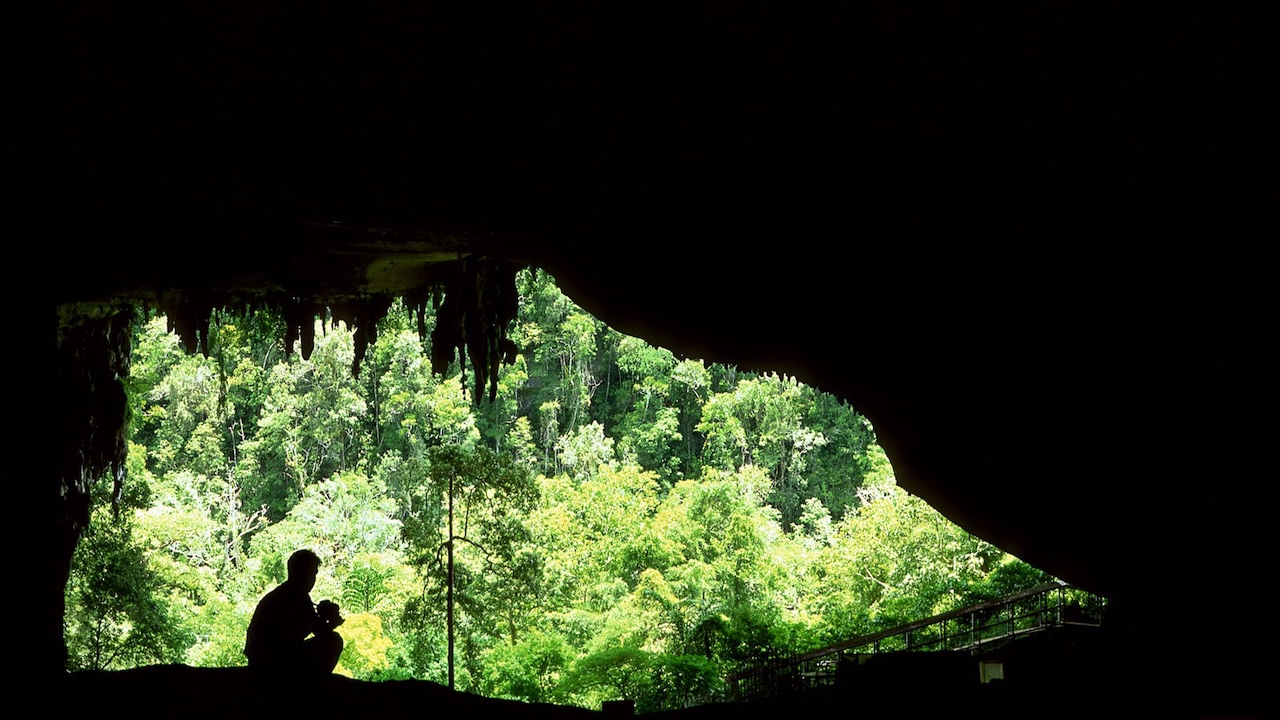
The massive Niah Caves Complex, which sits inside the Niah National Park, about 65 kilometers southwest of Miri, Sarawak, boasts of rich archaeological deposits, prehistoric rock paintings, and boat-shaped coffins. Photo credit: Courtesy of the Sarawak Tourism Board.
Deep in the jungles of Borneo, there is a maze of caves holding records, spanning at least 50,000 years, of how humans interacted with rainforests.
The massive Niah Caves Complex, which sits inside the Niah National Park, about 65 kilometers southwest of Miri, Sarawak, boasts of rich archaeological deposits, prehistoric rock paintings, and boat-shaped coffins. These artifacts provide evidence of how prehistoric humans adapted to their physical environment.
Because of the caves’ archaeological importance in providing insights into biological and human life in prehistoric times, the caves were added last year to UNESCO’s World Heritage Sites.
“The Niah Caves Complex is an outstanding example of very early human settlement and land use in the Southeast Asian region, and of human interaction with a changing environment during prehistoric times,” said UNESCO. The caves “contribute greatly to the knowledge of human development, adaptation, and migration in Southeast Asia, as well as in a global context.”
Living in the jungle
With Borneo, home to one of the oldest rainforests in the world, as the backdrop, Niah Caves boast of the longest known records of human interaction with this biodiverse ecosystem.
Evidence show the transition of human development and adaptation from foraging to rice farming, arboriculture, and “vegeculture.”
Nomination documents submitted by Malaysia to obtain UNESCO recognition said Niah Caves represent a site that contributes to knowledge of how humans in Southeast Asia survived around 8,000 and 4,000 years ago.
Citing various research, the nomination documents said there is archaeological evidence showing the Neolithic people buried in the caves were primarily rainforest foragers like the Mesolithic group before them. There is evidence that both groups may have cultivated domestic rice as well as nuts, fruits, sago palm, and tubers using the Niah Caves. This conforms with vegeculture, a system of forest management and resource enhancement that involves the tending, translocation, and vegetative reproduction of tuberous plants.
Archaeological records also found evidence of hunting and gathering, as seen in the wide variety of faunal remains found in the caves.
To this day, the Penans, a group of nomadic indigenous peoples in Sarawak, continue these practices as they are known to be foragers who still observe an ancient tradition of molong—take only what you need—when harvesting guano and bird’s nests from the caves.
Interestingly, there is also evidence Borneo did not originally have a rainforest ecosystem.
Animal bones dug from the caves show the effects of changing climates. Evidence of megafauna, such as rhinoceros, elephant, and tapir, indicate that the surrounding environment was not always the dense rainforest it is now but was probably a more open and drier forest.
By 11,700 BP, sea levels, temperatures, and rainfall began to rise, causing vegetation, and consequently the fauna, to progressively change to the tropical rainforest ecosystems that exist today.
Protecting the caves
Niah park is owned and managed by the state of Sarawak. It is legally protected at the national and state levels, with the earliest law enacted in 1951. In 1974, the Niah National Park was established, providing another layer of protection.
With Niah caves listed as a World Heritage Site, Malaysia now has five on the list, including Gunung Mulu National Park and Kinabalu Park, the Historic Cities of the Straits of Melaka, Melaka and George Town, and the Archaeological Heritage of the Lenggong Valley.
Malaysia’s Ministry of Tourism, Arts and Culture said the UNESCO recognition underscores the country’s commitment to protecting heritage sites.
“Indirectly, this accolade will also enhance Malaysia’s visibility on the world stage, making it a preferred destination for tourists,” the ministry said in a statement.
Including Niah Caves, BIMP-EAGA now has seven UNESCO World Heritage Sites. The other six are Lorentz National Park in Papua, Indonesia; Mt. Kinabalu Park in Sabah, Malaysia; Gunung Mulu National Park in Sarawak, Malaysia; Puerto Princesa Subterranean River in Palawan, Philippines; Tubbataha Reefs National Park, also in Palawan, Philippines; and Mount Hamiguitan Range Wildlife Sanctuary in Davao, Philippines.
UNESCO says these sites should be protected because they are “of outstanding value to humanity.” While BIMP-EAGA countries welcome tourists to these sites, they also strive to make sure these sites will continue to be enjoyed by future generations by protecting the sites from abuse.