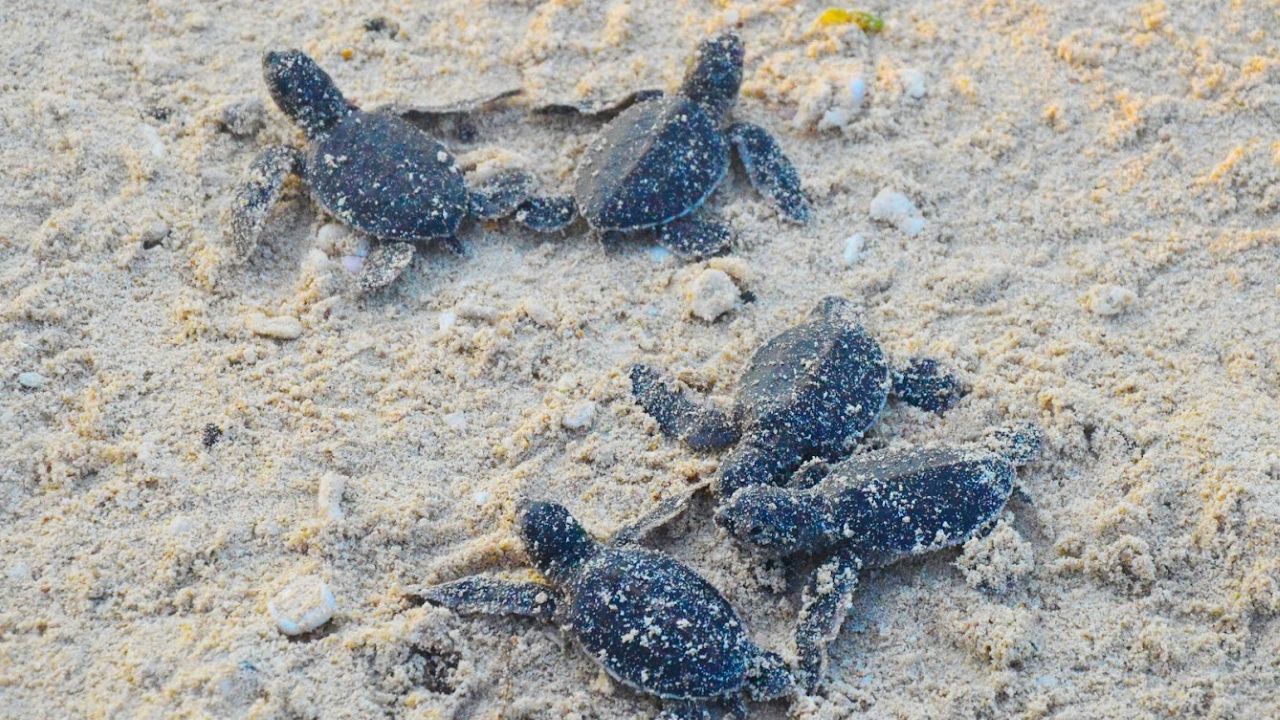
Hundreds of turtle hatchlings are released at the Turtle Islands Wildlife Sanctuary, but only a small percentage reach adulthood. Photo credit: Mindanao Development Authority.
The Philippines plans to develop the Turtle Islands as an eco-halal tourism destination. It has the potential to attract not just nature tourists but also visitors from neighboring islands in the BIMP-EAGA subregion where there are large Muslim populations.
Located in the Sulu Archipelago, the Turtle Islands are part of the remote province of Tawi-Tawi in the southernmost tip of Mindanao. Tawi-Tawi is in the Bangsamoro Autonomous Region in Muslim Mindanao (BARMM) and strategically located near Borneo and other areas of BIMP-EAGA.
Last year, the ASEAN Centre for Biodiversity declared the Turtle Islands Wildlife Sanctuary as the 60th ASEAN Heritage Park. The group of islands is a major nesting ground for the endangered green sea turtles (Chelonia mydas) in Southeast Asia. Established as a protected area of extremely high biodiversity conservation value in 1999, the 242,967-hectare sanctuary includes its surrounding waters and the islands of Baguan, Taganak, Boan, Great Bakkungan, Langaan, and Lihiman. All the islands are inhabited except for Baguan. The sanctuary hosts an average of more than 13,000 turtle nests every year. It is also included in UNESCO's Tentative List of World Heritage Sites.
As an ASEAN Heritage Park, the Turtle Islands becomes part of a network of protected areas. According to the ASEAN Centre for Biodiversity, this opens opportunities for knowledge sharing and support in protected area management, capacity development, and networking with regional and international conservation partners.
The turtle eggs were traditionally harvested and traded before these activities were made illegal. Today, the local communities work with the government to protect and preserve the turtles’ nesting grounds and have received training on alternative livelihoods, such as ecotourism operations. Aside from turtle watching, activities for tourists at the sanctuary include scuba diving, snorkeling, birdwatching, and nature walks through coastal forests and mangroves.
However, traveling to the turtle sanctuary is quite challenging for both domestic and international travelers. There are no direct flights to Tawi-Tawi from Manila, Cebu, or Davao, the major hubs in the country. One has to take a connecting flight either in Zamboanga City or Cotabato City to get to Tawi-Tawi’s provincial capital, Bongao. To reach the sanctuary from the capital, the only travel option is by sea, which can take 15 to 16 hours.
The Philippines is working to establish a connectivity circuit in Zamboanga that can make the Turtle Islands more accessible. There is also a proposal to jointly develop the sanctuary with Malaysia’s Turtle Island Park, which is an hour away by boat from Sandakan. The two parks form the Turtle Islands Heritage Protected Area, the world’s first transboundary protected area for sea turtles established by the two countries. They can be developed as a tourism circuit in the reconfigured and expanded West Economic Corridor, which is for development in the BIMP-EAGA subregion.
Meanwhile, the development of the Turtle Islands Wildlife Sanctuary into an eco-halal tourism site supports Mindanao’s aspirations of becoming the Philippines’ halal hub. It is ideally situated because of its proximity to large halal markets in Southeast Asia and halal ecosystems in BIMP-EAGA.
Though not a traditional destination for halal tourism, the Philippines has steadily increased its appeal to Muslim tourists by strategically developing its halal tourism portfolio, enhancing halal accreditation of hotels and restaurants, and conducting halal awareness orientations. In 2024, the country was given the Emerging Muslim-friendly Destination of the Year award at the Halal in Travel Global Summit.
The eco-halal tourism concept also aligns with the Mindanao Sustainable Tourism Development Advocacy, a framework for establishing Mindanao as “a premier destination for sustainable and inclusive tourism.” It prioritizes inclusive development, cultural preservation, and environmental stewardship.