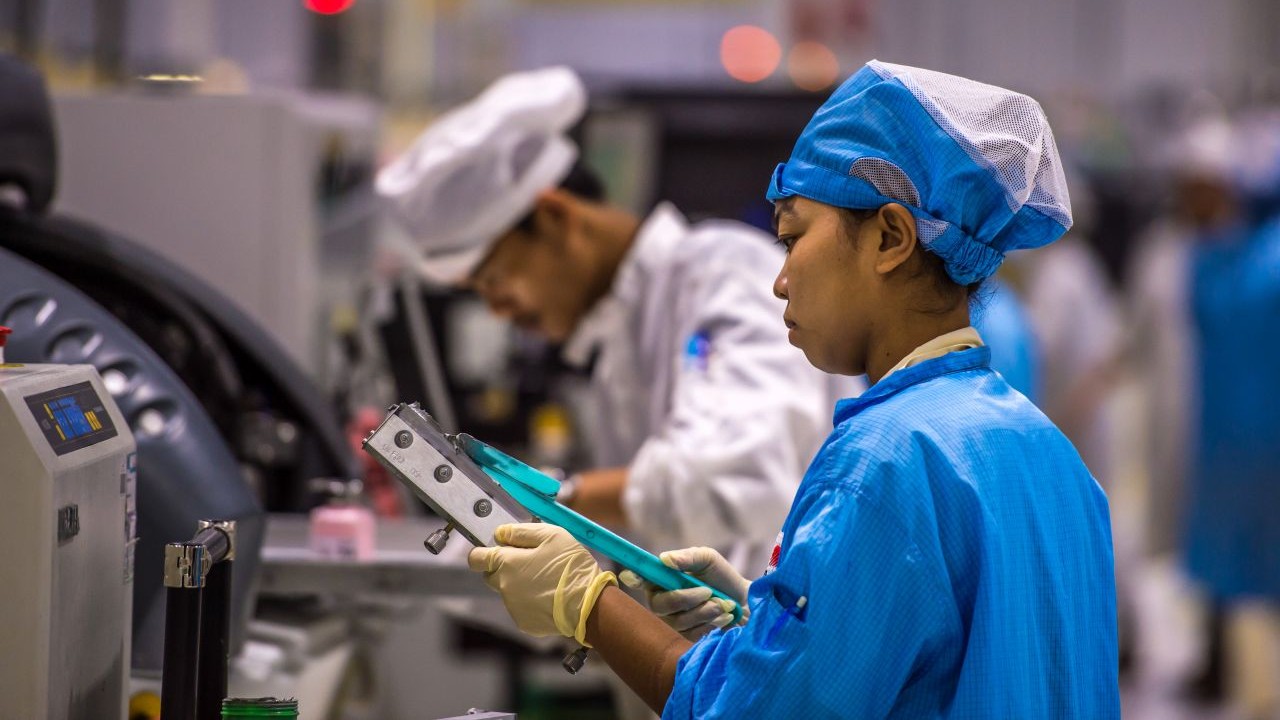
Workers at an electronics factory in Southeast Asia. Photo credit: ADB.
Growth forecasts in developing Southeast Asia for 2026 and 2027 slightly improved, according to a new report by the Asian Development Bank (ADB).
The Asian Development Outlook (ADO) September 2026 revised the projected gross domestic product (GDP) for developing Southeast Asia to 4.7% in 2026 and 4.9% in 2027 from ADO July 2026’s 4.6% and 4.8%. The report identified geopolitical tensions and a strengthening El Niño as the biggest risks to the outlook.
ADO monitors economies in the Asia–Pacific region. In the report, the developing Southeast Asia subregion groups the four countries of BIMP-EAGA—Brunei Darussalam, Indonesia, Malaysia, and the Philippines; Cambodia; Lao People’s Democratic Republic (Lao PDR); Myanmar; Thailand; Timor-Leste; and Viet Nam.
“Recent economic performance has been broadly resilient, but growth drivers are becoming more differentiated,” said the report. “In the first half of 2026, manufacturing and services sustained activity across much of the subregion, supported in some economies by resilient consumption and public spending. Elsewhere, high food and energy costs, an incomplete tourism recovery, delayed project implementation, and domestic uncertainty constrained demand and investment.” Meanwhile, the inflation forecast rose to 4.0% in 2026 from 3.9% in ADO July 2026 and to 3.3% in 2027 from 2.9% because of high energy prices.
Growth prospects are mixed across countries in developing Southeast Asia. ADO September 2026 upgraded the outlook for Viet Nam, which saw the largest increase, followed by Malaysia and Thailand. Forecasts were lowered for Brunei Darussalam, Cambodia, Myanmar, and the Philippines.
“Three broad factors explain the subregion’s diverging growth and prospects,” the report said. “Variations include the relative importance of technology-linked external demand, public investment and policy support, and domestic demand conditions.” These factors are reflected in the updated outlook for BIMP-EAGA countries.
The forecast for Brunei Darussalam was reduced to 1.2% in 2026 from 1.8%, while the outlook for 2027 was maintained at 1.9% in 2027. “Economic growth slowed in the first quarter (Q1) of 2026 as hydrocarbon production growth moderated and the non-oil and gas economy contracted,” the report said. “On the expenditure side, stronger household consumption, exports, and fixed investment partly offset a sharp decline in government consumption.”
The outlook for Indonesia is unchanged from ADO July 2026 at 5.2% in 2026 and 2027. Domestic demand and fiscal support drive GDP growth. “Lower energy prices and gradually strengthening private investment should support the 2027 outlook, while a stronger or prolonged El Niño, renewed oil price pressures, and elevated global interest rates pose important risks,” the report said.
The GDP forecast for Malaysia was revised up to 4.9% in 2026 from 4.6% and to 4.7% in 2027 from 4.5%. Growth in the first half of 2026 exceeded expectations, boosted by the investment upswing in semiconductors and data centers and supported by public infrastructure programs.
The outlook for the Philippines was downgraded to 3.3% in 2026 from the previous forecast of 3.8%. Weak public investment limited growth, while higher food and fuel prices, and soft labor market conditions dampened domestic consumption. “Continued strength in electronics exports should drive Philippine growth in 2026 and 2027,” it said.