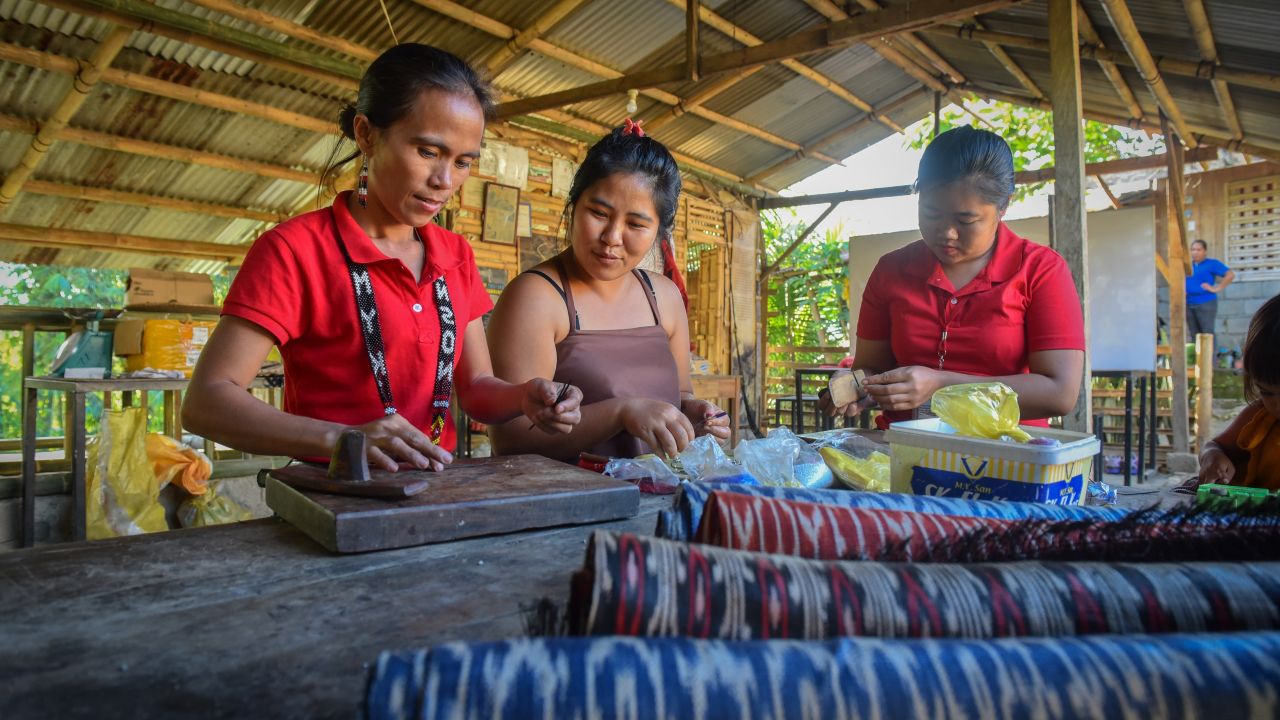
Increasing trade access for small businesses, such as those producing indigenous products, promotes sustainable and inclusive growth. Photo shows T'boli weavers of the T’nalak textile, an indigenous export product from South Cotabato in Mindanao, Philippines. Photo credit: ADB.
An ADB-supported initiative will enhance national Authorized Economic Operator (AEO) programs in BIMP-EAGA and make them more accessible to MSMEs.
Micro, small, and medium-sized enterprises (MSMEs) form the backbone of supply chains in Southeast Asia, accounting for more than 90% of all enterprises. While MSMEs employ 85% of workers and contribute nearly 45% to GDP in the region, their share in exports is only 18%.
Many of these enterprises, including those in the BIMP-EAGA subregion, struggle to integrate into global and regional value chains because they lack capacity to comply with complex customs requirements and international trade rules and procedures.
An initiative supported by the Asian Development Bank (ADB) seeks to increase the participation of MSMEs in Authorized Economic Operator (AEO) programs, which can make trading across borders easier for enterprises in the subregion. It will help improve national AEO programs for better supply chain management and faster cross-border trade, with greater focus on involving intermediaries in cross-border e-commerce.
Securing and facilitating trade
ASEAN member states, which include BIMP-EAGA countries, have committed to establishing national AEO programs based on the SAFE Framework of Standards to Secure and Facilitate Global Trade (SAFE FoS). The World Customs Organization (WCO) developed the framework to secure supply chains and facilitate trade of legitimate goods across borders.
An AEO is a party involved in international trade, including importers, exporters, customs brokers, freight forwarders, and carriers, that has been approved by or on behalf of a national customs administration as complying with WCO standards. AEOs enjoy such benefits as expedited processing and release, simplified procedures, fewer and priority inspections, and access to benefits under mutual recognition agreements (MRAs) with other countries.
In September 2023, all 10 customs administrations of ASEAN member states signed the MRA of their respective AEO program. The ASEAN AEO MRA provides assurance that AEO programs are compatible and follow the principles and standards of the WCO framework. It allows certified AEOs to enjoy faster cargo clearance and priority treatment for inspection within ASEAN, which will result in increased cost savings. This is expected to enhance intra-ASEAN trade by reducing regulatory burden and enable the seamless movement of goods.
The four BIMP-EAGA countries—Brunei Darussalam, Indonesia, Malaysia, and the Philippines—were among six ASEAN member states that piloted the implementation of the MRAs. By 2025, all six countries, which also included Thailand and Singapore, were fully implementing their ASEAN AEO MRA.
Limited resources and capacity
However, as in other regions across the world, only a few MSMEs in Southeast Asia have joined AEO programs. Microenterprises face the greatest barriers to participation.
“Compliance requirements can be resource-intensive,” said June Ghimire, Trade Specialist at ADB. “Large firms generally have the capacity to meet documentation, compliance, and security standards. But for MSMEs, these requirements can be a challenge, given limited resources, technical know-how, and administrative capacity. Customs administrations can level the playing field by tailoring and simplifying processes to better accommodate MSMEs.”
The WCO recognizes that it is important to make AEO programs accessible to MSMEs. It said “a focus on inclusivity for the eligibility of AEO programs and the tailoring of standards to the MSMEs' unique needs will serve to further expand opportunities for secure trade and increase sustainable economic growth of businesses of all sizes.”
MSMEs serve as suppliers and service providers within the supply chains of larger AEO-certified companies, many of which increasingly require their partners to hold AEO status.
“Facilitating MSMEs in AEO schemes not only supports inclusive economic growth and regional integration but also aligns directly with the development priorities of BIMP-EAGA and the broader ASEAN region,” said Ghimire.
Integration into global value chains
One of BIMP-EAGA’s goals is to expand trade in goods beyond $1.1 trillion over the next decade. The subregion focuses on building the capacities of MSMEs and deepening their integration into value chains.
Research shows enhanced trade facilitation raises participation in global value chains.
However, despite efforts to improve trade facilitation in BIMP-EAGA, impediments to cross-border trade persist, such as cumbersome customs, immigration, quarantine, and security (CIQS) procedures and weak information systems, which make it difficult for businesses—especially MSMEs—to navigate the trade landscape.
AEO participation will give small enterprises access to international markets and enhance their competitiveness through greater efficiency and lower costs. For MSMEs that depend on cross-border e-commerce or niche exports (e.g., agriculture, handicrafts), the benefits of AEO participation—faster clearance, lower transaction costs, and predictability—are often essential to survival in highly competitive markets.
Technical assistance to BIMP-EAGA under the ADB project includes providing capacity building support to improve AEO programs, and workshops in collaboration with the subregional economic cooperation program. The project will build on previous ADB-supported workshops on the AEO scheme and facilitate policy dialogue.