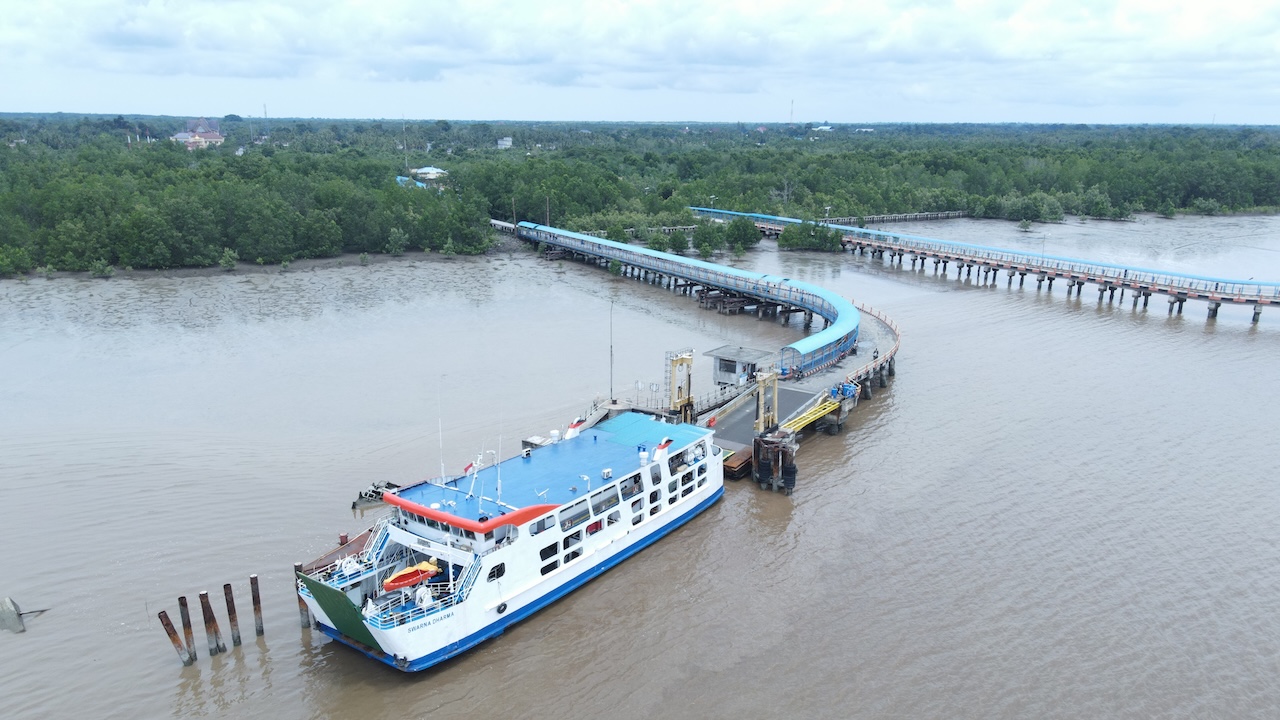
Under Indonesia's Vision 2045 strategy, Ro-Ros will serve as feeders linking remote regions to hubs which will then be served by container ships. Photo credit: iStock/Fikri Al Rifqi.
Indonesia wants to build a roll-on/roll-off (Ro-Ro) logistics network linking the eastern regions of Kalimantan, Sulawesi, Maluku, Papua, and Bali-Nusa Tenggara to bigger shipping hubs served by container ships to improve connectivity.
The plan, which aims to spur regional growth, would facilitate the transport of perishable commodities to regional processing centers, according to a new book that examines Indonesia’s Vision 2045 development agenda. The plan entails transporting agricultural and fishery products to Java, the country’s economic center, via container ships. The strategy is expected to improve output because waste generated by lengthy transportation time can be reduced significantly.
According to the book, for the strategy to succeed, Indonesia needs to reform port networks, tariff systems, and fleet capacity.
Under the Vision 2045 strategy, container ships will serve long-haul routes, while Ro-Ro will serve as feeders linking remote regions to hubs. “This integrated approach would combine the efficiency of large-scale container shipping with the flexibility and responsiveness of Ro-Ro services, creating a more resilient, inclusive, and regionally tailored maritime logistics network,” said Achieving the Golden Indonesia Vision 2045: Pathways and Challenges, which was published by the Asian Development Bank (ADB).
The strategy is part of a broader corridor-based development plan focusing on the agglomeration of economic activities in less advanced regions by creating economies of scale and building special economic zones.
The plan aligns with BIMP-EAGA’s strategy to develop economic corridors to better direct infrastructure investments to well-defined geographic spaces in the subregion. BIMP-EAGA's 10-year strategic roadmap, Vision 2035, provided for the expansion and reconfiguration of economic corridors into integrated networks. Under the one growth area approach, four interlinked economic corridors will be developed to capture emerging opportunities. These are the West Economic Corridor, Central Economic Corridor, North–South Economic Corridor, and East Economic Corridor (EEC), a new corridor.
The EEC includes East Kalimantan, North and South Sulawesi, the two Maluku provinces, and six Papua provinces. Its development aims to expand the influence area of the BIMP-EAGA value chain to remote regions in eastern Indonesia, which can serve as both product suppliers and consumer markets to other economic corridors in the subregion.
What is Ro-Ro?
Ro-Ro vessels are designed to transport cargo on wheeled vehicles, such as a truck, eliminating the need for cranes and other dock equipment to load or off-load cargo. Compared to conventional container shipping, Ro-Ro offers faster cargo turnaround in ports, simpler cargo handling, and lower infrastructure requirements. These make Ro-Ros well-suited for the short-haul, time-sensitive logistics common in eastern Indonesia. Perishable goods like fish and fresh produce particularly benefit from Ro-Ro’s speed and reduced handling times.
The model draws inspiration from the Philippine Nautical Highway System, a network of integrated Ro-Ro routes launched in 2003 that significantly improved interisland connectivity in a similarly archipelagic setting. Like the Philippines, eastern Indonesia faces structural constraints where limited market access reduces incentives to scale up agricultural production. Without reliable connections to larger markets, local producers cannot immediately access broader value chains.
To implement the plan, the government wants to rationalize the number of active ports across eastern Indonesia. Rather than maintaining a broad network of underutilized and subsidized facilities, it wants to rely on a smaller number of ports designated as parts of regional agglomeration centers. These ports will concentrate cargo flows, facilitate industrial development, and serve as nodes in a new Ro-Ro-based logistics network. This consolidation is expected to increase cargo volumes at key sites, make services more commercially viable, and gradually reduce dependency on public subsidies for maritime transport.
The book said this strategy signals a shift away from the current setup that relies on two international hub ports toward a more distributed network of collection points, supported by frequent, short-haul Ro-Ro routes or feeders.
The objective is to improve regional trade integration and food system resilience by ensuring the efficient and timely transport of agricultural and fishery products, promoting value-adding activities in agglomeration centers, and linking these products to higher-income markets in Java through existing domestic container shipping networks.
Complex Network
Eastern Indonesia has a network of 384 public ports. Only 25 are commercial ports and operated by state-owned enterprise Pelindo, while the majority are managed by the Ministry of Transportation as noncommercial government-funded facilities.
Only 41 of the public ports receive regular domestic container shipping services, but service frequency and reliability vary widely. While major ports like Makassar and Bitung benefit from daily connections and strong competition, remote ports may receive as few as just one container vessel per month.
The region also has 136 operational ferry ports. Some are co-located with public ports, while others stand alone. About 20 ferry ports are operated by state ferry company PT ASDP, with the rest managed by local governments depending on the routes. These ports are designed for small ships rather than the larger Ro-Ro ships.
Vision 2045’s agglomeration strategy aims to rationalize the port landscape by focusing development on a select group of key agglomeration ports.
Only seven ports in eastern Indonesia likely possess the necessary preconditions to serve as effective providers of container services sailing to Java and (potentially) international destinations, according to the book. The seven ports are in Makassar, Pantoloan, Bitung, Kendari, Kupang, Ambon, and Jayapura. Other ports would be gradually transformed to serve Ro-Ro shipping exclusively as cargo volume is low.
The book said the transition toward a more focused port network and reduced reliance on subsidies under Vision 2045 hinges on having a sound and well-aligned port tariff policy and having a modern fleet. Right now, the average age of the national fleet is 20 years, the typical economic lifespan of a commercial vessel. Old ships typically cost more to maintain and fuel.
Along with the Ro-Ro strategy, Indonesia is also planning a corridor-based development strategy for the region, focusing on agglomeration economies and special economic zones. This approach calls for integrated development where businesses, government agencies, and other actors interact and make the most of development opportunities. This will be an important challenge in eastern Indonesia as the region is characterized by economic fragmentation.