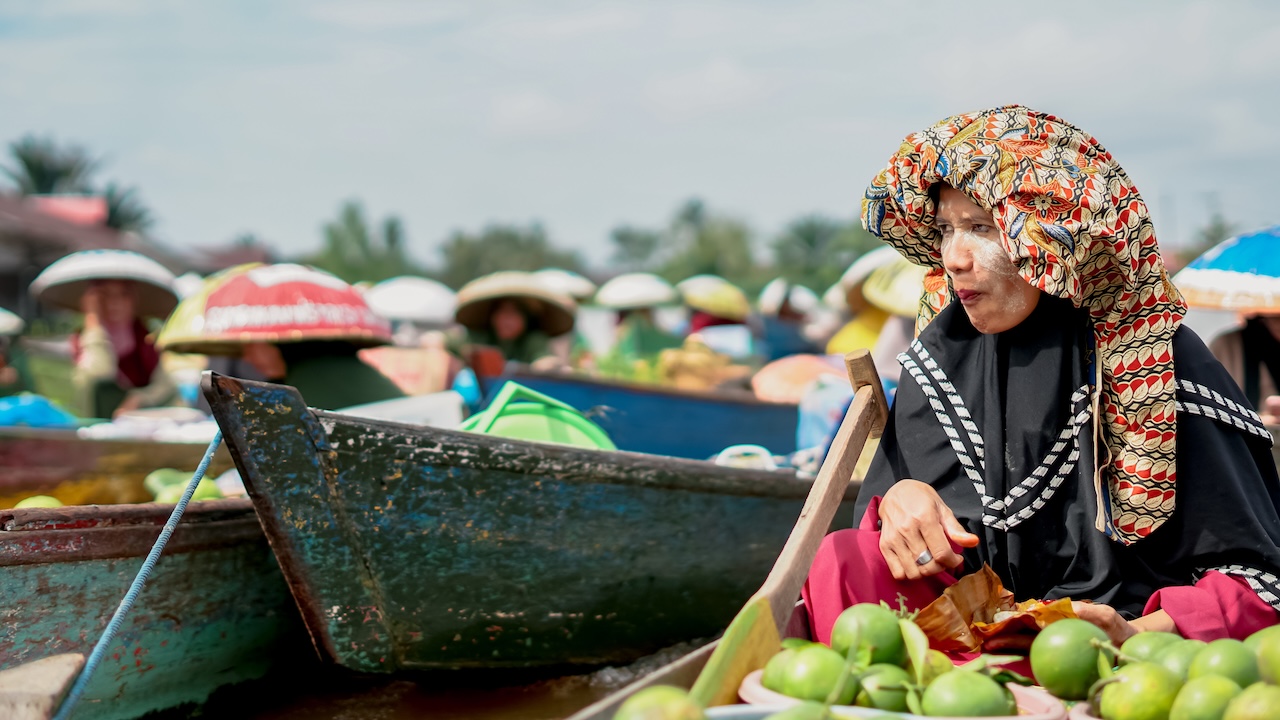
The eastern regions rely heavily on agriculture, fisheries, and mining while lacking a significant manufacturing base. Photo credit: iStock/Adennysyahputra.
Indonesia wants to accelerate development in its eastern regions and elevate their contribution to the national gross domestic product (GDP) to 28.5% by 2045 from 21.5% in 2022. To achieve this goal, the country devised a tailored approach that leans on the economic strengths of each region while improving connectivity to link growth hubs, special economic zones, and export markets.
According to a study that examines Indonesia’s 2045 development plan, meeting the GDP target would require eastern Indonesia’s economy to grow by 6.2%–9.9% annually, above the projected national average of 5.4%–6% between 2025 and 2045.
The country diagnostic study, entitled Achieving the Golden Indonesia Vision 2045: Pathways and Challenges, was produced by the Asian Development Bank (ADB) in collaboration with Indonesia’s National Economic Council and Ministry of National Development Planning/National Development Planning Agency (Bappenas).
The study noted that Indonesia cannot achieve its Vision 2045 goals without significantly accelerating economic development in the eastern regions as they lag behind Java, the country’s economic center, and the western regions in productivity, infrastructure, and market access.
Covering 39% of the country’s land area, the eastern regions rely heavily on agriculture, fisheries, and mining while lacking a significant manufacturing base. They face unique development challenges due to their sparse population, limited urban centers, and archipelagic geography separating production zones by sea.
Tailored approach
To spur development in its eastern regions, Indonesia is adopting a framework that features a differentiated, specialization-based approach that assigns each region distinct economic identities aligned with its comparative advantages. This framework is laid out in the country’s Vision 2045 development agenda.
With this tailored approach, the government seeks to develop Kalimantan as a green industry superhub, Sulawesi as an industrial and national food security nexus, Maluku as a maritime hub, Papua as an indigenous-centered social-first region, and Bali-Nusa Tenggara as an international tourism center.
Except for Bali-Nusa Tenggara, the regions are among the areas covered by BIMP-EAGA in Indonesia. BIMP-EAGA is a cooperation initiative that aims to spur development in remote and less developed areas in four countries—Brunei Darussalam, Indonesia, Malaysia, and the Philippines.
According to the study, eastern Indonesia’s economy exhibits a striking duality that complicates development strategy. On the one hand are enclave, large-scale, capital-intensive mining operations, predominantly involving multinational enterprises equipped with sophisticated technology and integrated into global supply chains. On the other hand, there is a vast landscape of small and micro-scale economic activities in natural resource sectors, particularly fisheries, agriculture, and plantations. These activities employ the majority of eastern Indonesia’s workforce—around 41.3% in agriculture, forestry, and fishing alone—but generate disproportionately small shares of output and income.
To address eastern Indonesia’s fragmented economic activity and weak industrial clustering, Vision 2045 seeks to concentrate economic activities in selected regional growth hubs, build economies of scale, and develop agglomeration centers linked to special economic zones (SEZs) and industrial clusters.
This is aligned with BIMP-EAGA’s development strategy. For instance, the cooperation program is employing the economic corridor strategy to better direct infrastructure investments to well-defined geographic spaces in the subregion. BIMP-EAGA’s 10-year strategic roadmap, Vision 2035, provides for the expansion and reconfiguration of economic corridors into integrated networks. Under the “one growth area” approach, four interlinked economic corridors will be developed to capture emerging opportunities.
Parts of Indonesia’s eastern regions fall under BIMP-EAGA’s new economic corridor, the East Economic Corridor (EEC). EEC covers North Sulawesi, Central Papua, East Kalimantan, Highland Papua, Maluku, North Maluku, Papua, South Papua, South Sulawesi, Southwest Papua, and West Papua.
BIMP-EAGA's newly approved corridor strategy identified EEC as having the highest potential for growth in fisheries and tourism. The new corridor is expected to create more economic opportunities for Papua and Maluku, which are among the most underdeveloped areas in eastern Indonesia, and accelerate investments in energy and other basic infrastructure.
Designed to enhance connectivity and trade, EEC and the other three corridors are envisioned to function as a network. Over time, it is expected that more overlaps or interlinks across corridors will develop as the subregion moves toward becoming one seamless BIMP-EAGA growth area.
Indonesia's Vision 2045 also seeks to bolster growth in the easter regions by improving connectivity. The government plans to develop a roll-on/roll-off logistics network, wherein smaller ports would feed goods into larger agglomeration ports, which would then connect to national and potentially international shipping networks. The approach aims to reduce transport time, lower spoilage of perishable goods, improve market access, and reduce logistics costs.
Areas of specialization
Together, improved connectivity and region-specific specialization form the foundation of Indonesia's strategy to accelerate growth in its eastern regions.
Kalimantan. Indonesia’s plan to relocate the capital from Jakarta to Nusantara on the eastern coast of Borneo provides a strategic foundation for new economic growth clusters, including additional special economic zones and sustainable growth centers.
Focus zones will support downstream processing of minerals, including not just copper and tin, but also coal, nickel, and bauxite, strengthened through the Trans-Kalimantan Road network and rail networks.
Sulawesi. The development strategy revolves around three growth poles. The first focuses on mineral downstreaming, with industrial zones such as Morowali supporting nickel processing for the global electric vehicle supply chains. The second centers on agriculture and fisheries, reinforcing Sulawesi’s role as a national food security hub through fruit and fish processing. The third is anchored around Bitung, which serves as a center for fisheries and fish processing for eastern Indonesia.
The strategy requires substantial infrastructure and logistics investments. Processed minerals, agricultural outputs, and fishery products need sea transport through overseas connectivity.
Maluku. The region is envisaged as Indonesia’s main maritime hub. Marine products from the region will be sold throughout the nation and exported. The vision calls for downstream processing of marine products to generate higher value added and incomes of the region’s inhabitants, with special economic zones playing a key role in processing. The strategy also calls for developing shipbuilding facilities and maritime techno parks. Maritime products’ perishability requires cold chain facilities and adequate maritime shipping networks.
Exports require rapid access to regional maritime hubs, and connectivity within and between regions is key to successfully introducing a maritime sector capable of export. The success of special economic zones depends heavily on substantial investments in maritime logistics infrastructure.
Papua. The development strategy for the region recognizes that economic growth must be grounded in strengthened health and education, given the high incidence of poverty and poor public health.
The strategy is twofold. First, strengthen health, education, and entrepreneurship as the foundation for sustainable development. Second, develop special economic zones to produce food for local markets and trade with other Indonesian regions, boosting incomes. The strategy focuses on improved health and education to lay the foundation for regional entrepreneurship, though this requires time and vocational training. Connectivity and market access are critical.
However, current food estate experiences in Papua, particularly in Merauke, show mixed results with multiple factors needing consideration, as food estates tend to develop as enclave economies with limited benefits to regional populations.
While the development pathways differ across regions, the study notes that they share a common feature: the creation and strengthening of agglomeration centers, including special economic zones, as key instruments for driving regional growth. In this way, Vision 2045 seeks to combine region-specific strengths with stronger connectivity and industrial clustering to accelerate development across eastern Indonesia.