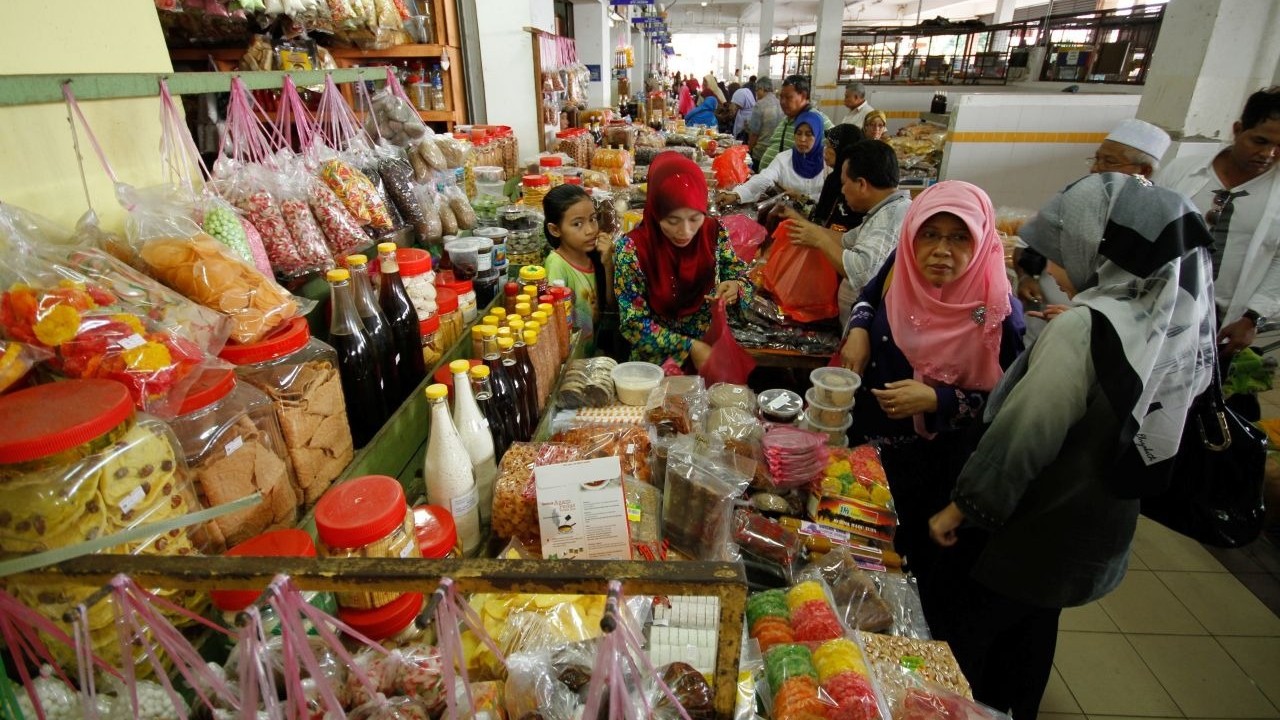
The Government of Malaysia will support the upscaling of local small and medium-sized enterprises for the export market and promote the manufacturing of high-value products at halal industrial parks. Photo credit: ADB.
Malaysia is cementing its foothold in the global Islamic economy by capitalizing on its strategic location, end-to-end halal ecosystem, and advances in Islamic finance.
The country is being positioned as a halal manufacturing and logistics hub, connecting global supply chains with emerging halal markets in BIMP-EAGA, the greater ASEAN region and beyond. It has designated 14 Halal Malaysia (HALMAS) Parks across the country, which includes two on the island of Borneo—Tanjung Manis Halal Hub and Kota Kinabalu Industrial Park.
According to state-backed Halal Development Corporation Berhad (HDC), these halal parks provide “a structured platform to anchor investments and facilitate industry clustering within a coordinated halal ecosystem,” supported by a certification process that is recognized in more than 47 countries, including Saudi Arabi and other Gulf states.
Global leader
The global Islamic economy grew 7% to $2.60 trillion in 2024 from $2.43 trillion, according to the State of the Global Islamic Economy Report (SGIE) 2025/26 produced by DinarStandard, a research and advisory firm in the United States. It is projected to expand to $3.56 trillion by 2029, while Islamic finance assets are estimated to reach $9.72 trillion.
For the 12th year, Malaysia retained the top spot in the Global Islamic Economy Indicator (GIEI) index cited in the report, followed by the United Arab Emirates (UAE), Saudi Arabia, Indonesia, and Bahrain. The index, which is made up of 49 metrics, evaluates performance across seven key sectors: halal food, pharmaceuticals, cosmetics, modest fashion, travel, media and recreation, and Islamic finance.
Malaysia also continued to lead the Islamic Finance Development Indicator (IFDI) rankings in 2025, followed by Saudi Arabi and the UAE. IFDI is produced by LSEG, a financial markets infrastructure and data provider in the United Kingdom.
“Malaysia and the UAE placed within the top five for each of the IFDI’s five key indicators,” said the Islamic Finance Development Report 2025, which was published by the Islamic Corporation for the Development of Private Sector (ICD) and LSEG. The countries are scored in terms of financial performance, governance, sustainability, knowledge, and awareness. The report said Iran, Saudi Arabia, and Malaysia account for $4.3 trillion or 72% of global Islamic finance assets in 2024. Total Islamic finance assets of Malaysia amounted to $761 billion.
For 11 years straight, Malaysia has been the top Muslim-friendly destination in the Global Muslim Travel Index (GMTI), followed by Indonesia, Türkiye, and Saudi Arabia, which shared second place. The annual GMTI report is published by Mastercard, a global payments network, and CrescentRating, which provides Muslim-friendly travel ratings and accreditation services.
Most developed market
Based on IFDI, Malaysia is considered the most developed Islamic finance market today.
“As of 2024, Islamic financing accounts for over 46% of Malaysia’s total financing, while the Takaful sector accounts for nearly 24% of industry premiums. Malaysia also accounts for a 36% share of outstanding global sukuk,” said the ICD–LSEG report.
Takaful, which means “joint guarantee,” is an Islamic system of insurance where participants agree to contribute to a common fund to protect each other against loss or risk. Sukuk is an interest-free bond that generates returns to investors.
Strategic sector under 13MP
The halal industry is one of the strategic sectors under the 13th Malaysia Plan (2026–2030). The 5-year socioeconomic roadmap is targeting to increase halal exports to RM80 billion (about $19 billion) by 2030 from RM61.8 billion in 2024 and raise the contribution of the halal industry to the gross domestic product to 11% from 7.7%.
The governance and development of the country’s halal ecosystem will be strengthened by creating a halal commission, which is envisioned as a “hub for standards of the global halal industry.” The government will support the “upscaling of local small and medium-sized enterprises and promote the manufacturing of high-value products at halal industrial parks.
As part of efforts to advance Islamic finance, Malaysia also plans to develop Islamic financial solutions, including green financing, to support the growth and sustainability of the halal supply chain.
Halal gateway in BIMP-EAGA
The country is promoting East Malaysia as a halal gateway in Borneo and in the BIMP-EAGA subregion. Sarawak’s capital Kuching started the Borneo International Halal Showcase (BIHAS) this year, an annual event that is being promoted as a trade platform for halal products and services. The state government launched the Sarawak Halal Industry Development Plan 2026–2030 at the event. The 5-year plan includes strengthening cross-border halal trade along BIMP-EAGA economic corridors.
Sarawak is at the doorstep of major halal markets in Southeast Asia—Brunei Darussalam and Indonesia, the world’s largest Muslim-majority country. It is included in BIMP-EAGA’s expanded and reconfigured West Economic Corridor along with the Federal Territory of Labuan and Sabah, all four districts of Brunei Darussalam, Indonesia’s West Kalimantan province, and seven provinces of Mindanao in the Philippines, which also have large Muslim populations. The corridor will be developed as a transport and logistics corridor and has potential to become a financial and digital hub. The Federal Territory of Labuan aspires to become a digital gateway with Islamic finance capabilities for different types of global investors and players, including those looking for environment, social, and governance (ESG) investments.
Another expanded BIMP-EAGA corridor, the Central Economic Corridor, groups Sarawak with Sabah, four Kalimantan provinces, and six provinces in Mindanao. This corridor is being eyed for the trade of halal-certified goods.
The two HALMAS parks in Borneo are expected to play a key role in achieving Malaysia’s halal midterm goals.
The Tanjung Manis Halal Hub is strategically located at the delta of the Rajang River. Tanjung Manis has its own port and airport. The halal park focuses on agriculture, aquaculture, and food production and processing.
The halal hub at the Kota Kinabalu Industrial Park will be “a one-stop center offering technology facilities and certification support,” particularly for small and medium-sized enterprises. The industrial park is a self-contained township with commercial and residential areas. It is 20 kilometers from the central business district, 28 km from the Kota Kinabalu international airport, and 7 km from Sepanggar Container Port. .