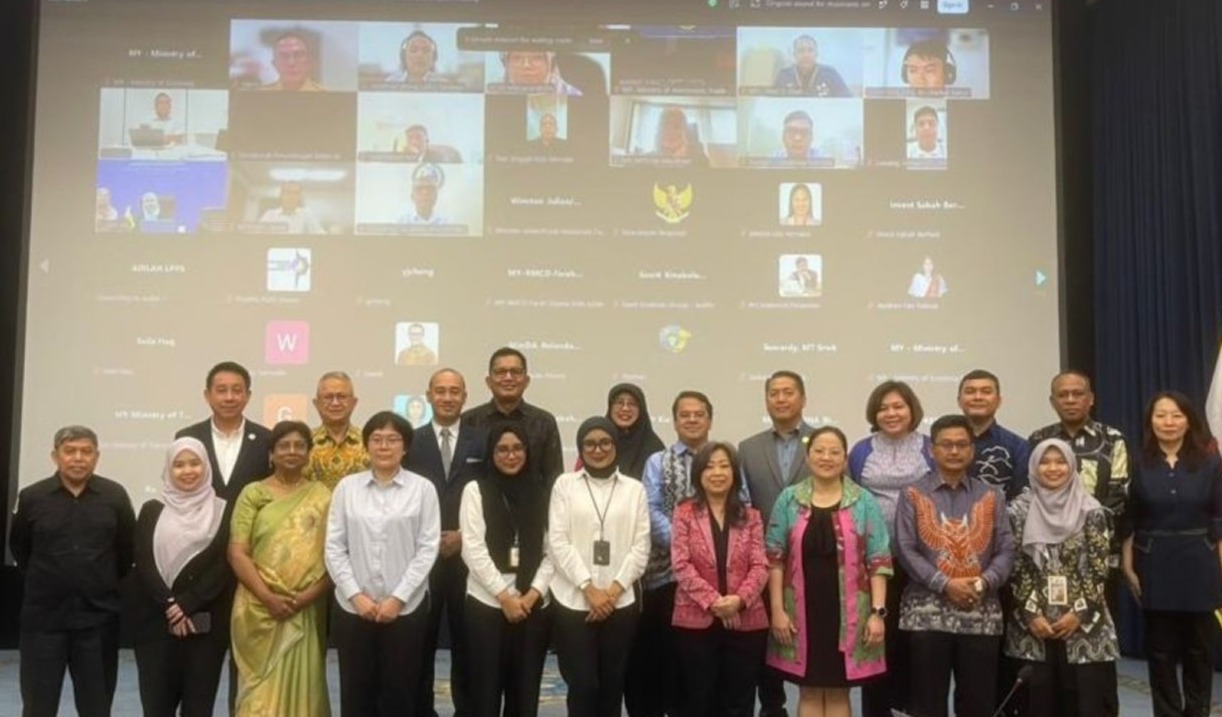
An inception meeting of the Economic Zones Working Group (EZWG) was held on Monday, 29 June 2026, in Jakarta to consult stakeholders on the proposed role, functions, structure, and membership of the EZWG as well as identify initial areas for collaboration.
BIMP-EAGA convened an inception meeting of the new Economic Zones Working Group (EZWG) on Monday, 29 June, in Jakarta. The consultative meeting was led by Indonesia, which currently chairs the subregion’s Trade and Investment Facilitation and Promotion Cluster. It discussed the rationale and proposed role, functions, structure, and membership of the EZWG as well as identified initial areas for collaboration.
“Last month, BIMP‑EAGA Leaders endorsed Vision 2035, a commitment to build a more connected region and accelerate shared growth. Achieving this requires us to link our economic zones with the trade routes that bind our subregion,” said Irfan Adhitya Permadi, who heads the APEC and Sub Regional Economic Cooperation Division of Indonesia’s Coordinating Ministry for Economic Affairs (CMEA), in his welcome remarks. He is also a member of Indonesia’s national secretariat for BIMP-EAGA.
“Today, we have many economic zones, but they still operate too independently. To move forward, we need to strengthen coordination and establish a shared platform for joint planning,” Permadi said.
Representatives from BIMP-EAGA member countries, economic zone authorities, representatives of the Chief Ministers, Governors, and Local Government Forum (CMGLF), BIMP-EAGA Business Council, other private sector stakeholders, and development partners, including the Asian Development Bank (ADB) as regional development advisor, attended the meeting.
The BIMP-EAGA Senior Officials Meeting endorsed the creation of a dedicated working group for economic zones under the Trade and Investment Facilitation and Promotion Cluster in November 2025 in Davao City, as part of institutional enhancements under BIMP-EAGA Vision (BEV) 2035. This was further reinforced during the February 2026 Strategic Planning Meeting in Bandar Seri Begawan, where the senior officials requested technical and advisory support from ADB to operationalize EZWG.
Key role in regional connectivity and integration
Economic zones across BIMP-EAGA are expanding in number and scope. These are government-designated or approved industrial estates, which include special economic zones (SEZs), industrial parks, business parks, technology or science parks, and halal parks.
Economic zones have the potential to accelerate regional connectivity and integration as well as advance the subregion’s inclusive and sustainable goals. SEZs, in particular, have helped businesses to engage in export-oriented manufacturing and become part of global value chains.
A study by ADB on the role of SEZs in economic corridors shows how BIMP-EAGA can create a single market and production base through cooperation and competition for investment in economic zones. The subregion has an abundance of raw materials and provides a strategic location for investors who want to minimize the cost of trade and logistics in reaching major markets in Asia and Europe.
The need for a dedicated platform
However, coordination in the development of economic zones remains fragmented across national, subnational, and sectoral levels.
A survey of stakeholders conducted by ADB shows that policy and regulatory gaps have limited trade and investment flows. Economic zones often operate in silos and compete with each other. There is lack of data and evaluation and monitoring systems to support evidence-based planning and decision-making. These issues underscore the need for increased cooperation to improve policy coordination, regulatory harmonization, systems integration, data and knowledge sharing, and transparency and monitoring. There should also be joint promotion and marketing to strengthen BIMP-EAGA’s positioning to attract investors.
The EZWG is envisioned to provide a dedicated platform for strengthening coordination among stakeholders on ongoing and planned economic zone initiatives. It will align SEZs development with strategies under BEV 2035 to develop the subregion’s reconfigured, expanded, and interlinked economic corridors. It is also expected to promote cross-border investment linkages and regional value chains.
The new working group will “provide a clear structure to connect local economic zones with regional trade corridors, bridge coordination gaps among authorities, and—most importantly—enable us to present ourselves as a unified, synergized economic ecosystem,” said Permadi. “By doing so, we will significantly enhance our ability to attract investment into the region.”